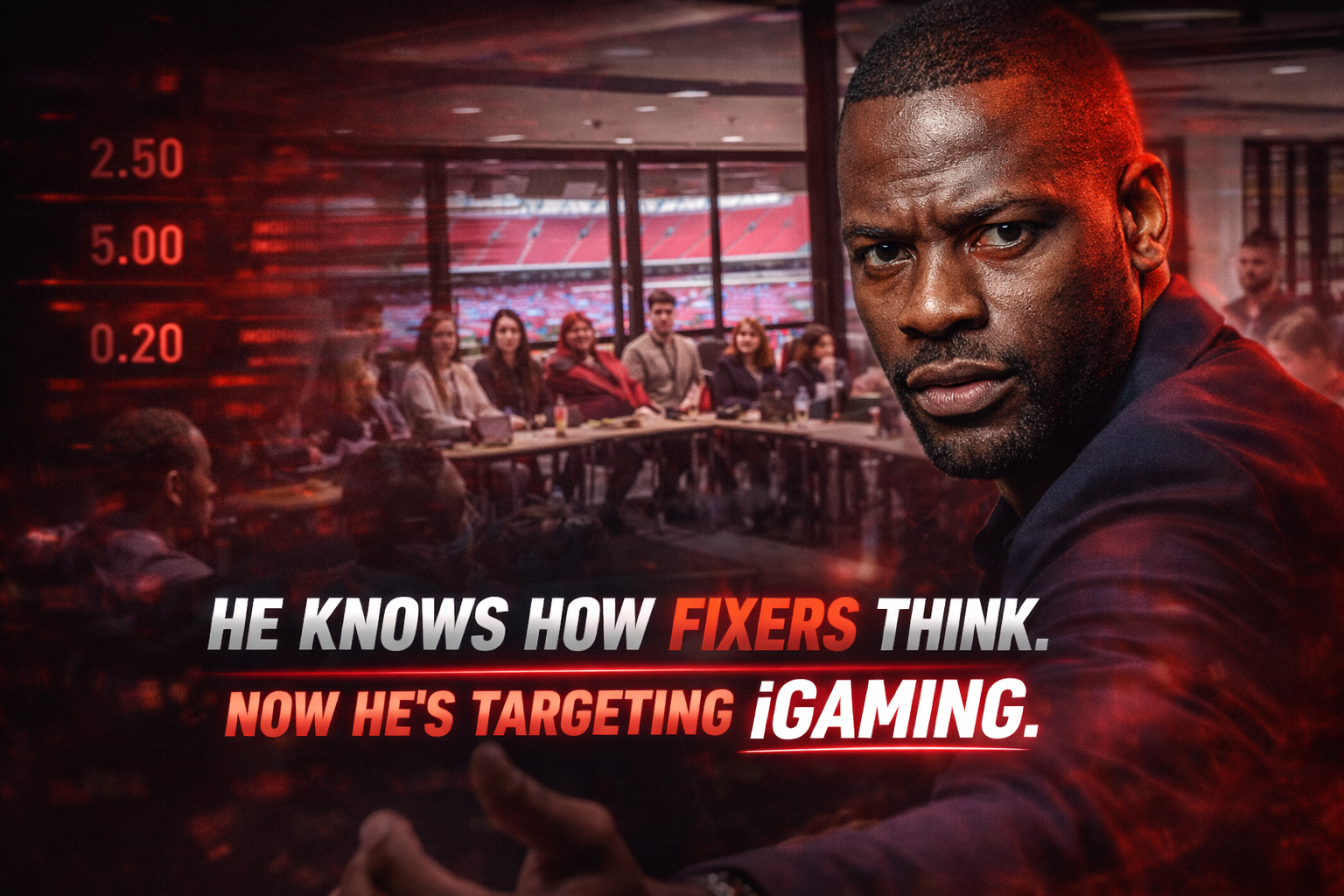
The iGaming industry is about to hear from someone who once knew exactly how to beat it.
Moses Swaibu, the former English footballer jailed for match fixing, is re-emerging — not as a player, but as an AI-powered integrity entrepreneur targeting the booming U.S. sports betting market ahead of the FIFA World Cup.
And this time, he says he’s building tools to stop the very schemes he once helped execute.
From Fixing Matches to Fighting Betting Manipulation
More than a decade ago, Swaibu was part of a global betting manipulation network that infiltrated lower-league English football. Today, he claims that experience gave him something sportsbooks and regulators desperately need: insider intelligence.
In an era where U.S. sports betting handles are breaking records and international tournaments are driving unprecedented liquidity, Swaibu argues that operators are still missing a key defensive layer — athlete education.
“Sportsbooks monitor bets,” he has said in recent presentations. “But who is monitoring the mindset of the athlete?”
That’s where his company enters.
Why This Story Matters to iGaming Operators
Let’s be clear: match fixing is not just a sporting scandal. It’s a direct threat to sportsbook profitability.
When a game is manipulated:
- Odds models are compromised
- Sharp money patterns distort markets
- Operators face regulatory scrutiny
- Brand trust suffers
For iGaming companies, integrity failures can mean multi-million-dollar exposure and long-term reputational damage.
With the World Cup expected to generate billions in global betting turnover, the risk multiplier increases dramatically.
Swaibu’s pitch? Prevention should begin before suspicious bets hit the system.
Introducing GameChanger 360: AI Meets Integrity
After serving his sentence, Swaibu spent years working with football authorities and integrity officials. Eventually, he founded GameChanger 360, an AI-driven platform designed to train athletes on how match-fixing syndicates operate.
Unlike traditional compliance briefings, GameChanger 360 uses:
- AI-powered learning modules
- Real-world fixer simulation scenarios
- Behavioral risk mapping
- Confidential reporting tools
- Psychological vulnerability analysis
According to Swaibu, fixers no longer approach athletes with briefcases full of cash. Instead, they build relationships, offer emotional support, and exploit financial pressure.
That subtle approach is harder for sportsbooks to detect through betting analytics alone.
U.S. Betting Market: A Perfect Storm?
The expansion into the United States is no coincidence.
Since the repeal of PASPA, the U.S. sports betting market has evolved into one of the most lucrative in the world. At the same time, betting-related investigations in college and professional sports have increased.
High-profile cases, including betting violations involving Calvin Ridley, have highlighted how easily athletes can cross regulatory lines — sometimes without malicious intent.
For operators, these incidents create ripple effects:
- Increased regulator audits
- Public relations challenges
- Stricter compliance demands
Swaibu believes education could act as a buffer between temptation and scandal.
The AI Arms Race in Betting Integrity
Here’s where the story gets more interesting.
Modern betting syndicates use:
- Advanced data modeling
- Real-time in-play market tracking
- Encrypted communication
- Crypto payment systems
Sportsbooks counter with:
- Fraud detection algorithms
- Market monitoring systems
- AML protocols
Now Swaibu is positioning athlete-focused AI education as the third layer in this integrity arms race.
Instead of reacting to suspicious betting patterns, his model attempts to eliminate manipulation at its source.
For iGaming executives, that could represent a new compliance frontier.
A Commercial Opportunity for Operators?
While GameChanger 360 markets itself as an athlete education tool, the broader question is whether sportsbooks should partner with such platforms.
Could operators:
- Sponsor integrity training programs?
- Integrate reporting pipelines?
- Reduce liability exposure through proactive prevention?
With the World Cup approaching and betting volumes expected to spike across U.S. markets, the conversation is becoming urgent.
Integrity is no longer just a regulatory requirement. It may become a competitive advantage.
Redemption Story — or Strategic Rebrand?
Swaibu’s journey from convicted match fixer to integrity advocate is undoubtedly dramatic. However, for the iGaming industry, the more important question is practical:
Can someone who once understood how to manipulate betting markets now help protect them?
As global betting ecosystems become more sophisticated and cross-border enforcement becomes more complex, insider knowledge may carry unique value.
What is certain is this: with billions set to flow through sportsbooks during the World Cup, operators cannot afford blind spots.
The Bigger Picture for iGaming
The sports betting industry is maturing. Margins are tightening. Regulators are watching closely. Public scrutiny is rising.
In that environment, integrity solutions — especially AI-driven ones — are not just ethical add-ons. They are strategic necessities.
Moses Swaibu is betting that his past gives him an edge in shaping that future.
And as the U.S. prepares for the biggest football tournament on the planet, the iGaming sector may soon decide whether to view him as a former threat — or a new ally in protecting betting markets.